
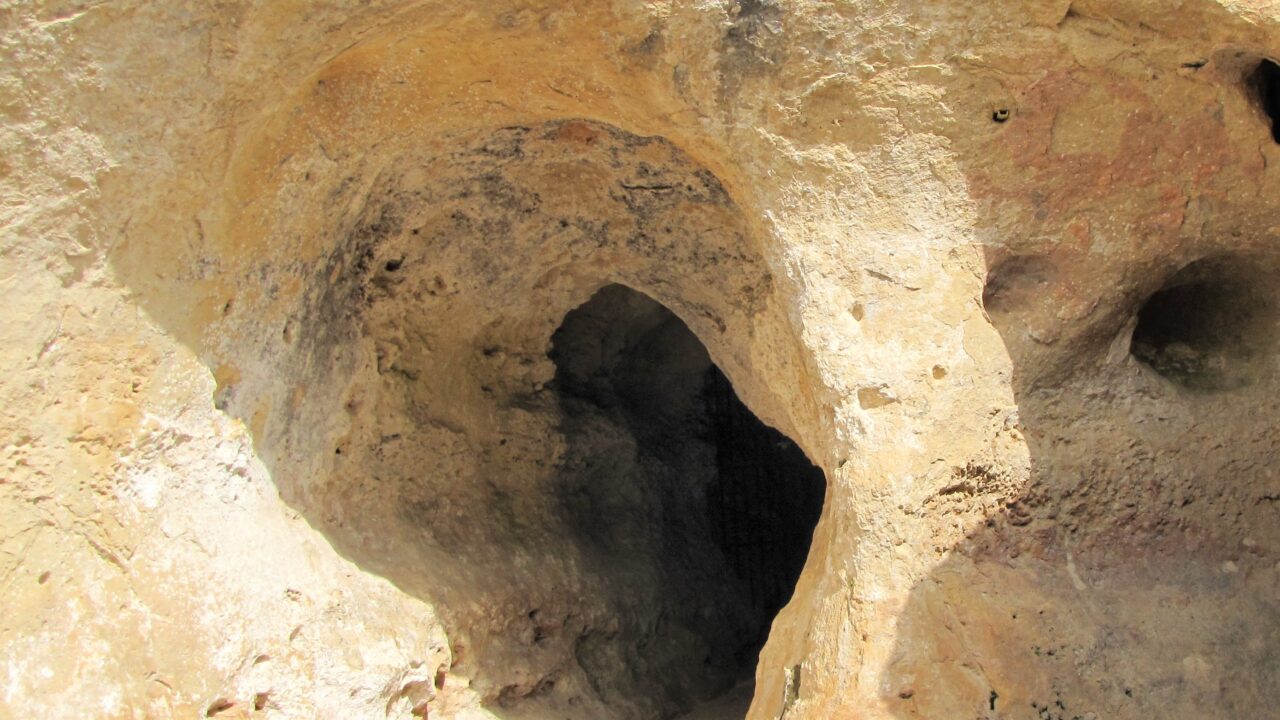
A rare original, not a replica
At Les Eyzies-de-Tayac, in the heart of the Vézère valley in the Dordogne, Font-de-Gaume is one of the last major caves with polychrome paintings still open to the public. Its Magdalenian frescoes, 13,000 to 16,000 years old according to the first direct datings published in 2026, are among the most moving in prehistory. Here you see the real thing, not a facsimile, which is exactly why the visit is so limited.
A frieze of bison
Along a narrow gallery runs a long frieze of bison painted in red and brown, picked out in black. The artists used the natural relief of the rock to give the animals body, in a refined art of colour and volume. Horses, mammoths and reindeer complete the menagerie, on nearly two hundred figures.
The reindeer face to face
The most famous scene shows two reindeer facing each other: the male lowers his head and seems to lick the forehead of the female kneeling before him. This image of rare tenderness is one of the masterpieces of Palaeolithic art.
What you really see
The Centre des monuments nationaux (CMN), which runs the cave, counts about 230 images, painted or engraved, including more than two hundred animals. The bison dominates by far, with 84 depictions of the steppe bison, a species extinct for about 10,000 years.
- About fifteen reindeer, including the famous pair.
- Three black horses in the side gallery; the one on the left is caught mid-leap, a rare pose in cave art.
- A herd of mammoths, engraved and painted, which you have to look for in the main gallery.
- 26 tectiforms, roof-shaped signs also found at Les Combarelles, Bernifal and Rouffignac.
The figures combine line drawing, flat colour in red, brown and black, and fine engraving for details. The artists also chose their walls with care: in the side gallery the complex relief of the rock gives the horses their volume. That marriage of colour and relief is what made the polychromes of Font-de-Gaume famous.
How old are the paintings?
For a century the age was estimated by comparing styles. The CMN places the decoration in the middle Magdalenian, around 14,000 BC. In March 2026 a CNRS team published in the journal PNAS the first direct datings of Palaeolithic paintings in the Dordogne: charcoal found in the black pigment of two drawings, a bison (about 13,300 years, calibrated) and a mask (some parts close to 16,000 years). Only two figures out of more than two hundred have been dated, so this does not date the whole cave.
1901: the discovery
On 12 September 1901 Denis Peyrony, a schoolteacher at Les Eyzies, climbed the rock alone, looking for a cavity known to local people. By candlelight he squeezed through a narrow passage and found the paintings, the first polychrome paintings ever found in France. Louis Capitan and the Abbé Henri Breuil joined him on 20 September. The find helped end decades of doubt about whether Ice Age cave art was real, and together with the neighbouring Combarelles it made Les Eyzies the world capital of prehistory.
Why you can still go in
The cave was given to the State in 1902 and listed as a historic monument the same year. It opened to visitors in 1910 and, in the 1960s and 1970s, received up to 1,500 people a day in summer. After the closure of Lascaux in 1963, quotas tightened. The CMN now gives a maximum of 78 people a day, in six visits. The heat from bodies is the main threat: the cave must return to its natural temperature every night. The CMN considers the climate and biology of the cave stable "for now", depending on how the climate evolves.
Planning your visit
- Book: a time slot booked online is compulsory. Tickets are checked 15 minutes before departure.
- The approach: about 400 metres of steep, narrow path lead to the entrance, so wear good shoes.
- Inside: about 14 °C, dim light, a winding corridor and nowhere to sit. Visits are for children aged 7 and over.
- Rules: no bags, no photos, no filming. Dogs are not allowed, except guide dogs.
Nearby at Les Eyzies
The cave belongs to the UNESCO World Heritage property "Prehistoric Sites and Decorated Caves of the Vézère Valley" (1979). Several stops are minutes away: Les Combarelles, the sister cave found the same week and almost entirely engraved; the Cap Blanc rock shelter, with a sculpted frieze of horses about 15,000 years old; and the National Museum of Prehistory, where a combined ticket with Font-de-Gaume exists. For the bigger picture see our Vézère valley weekend and the guide to painted caves.
Practical information was checked in October 2026: please confirm opening times and book on the official website before your visit.