An original cave, still open
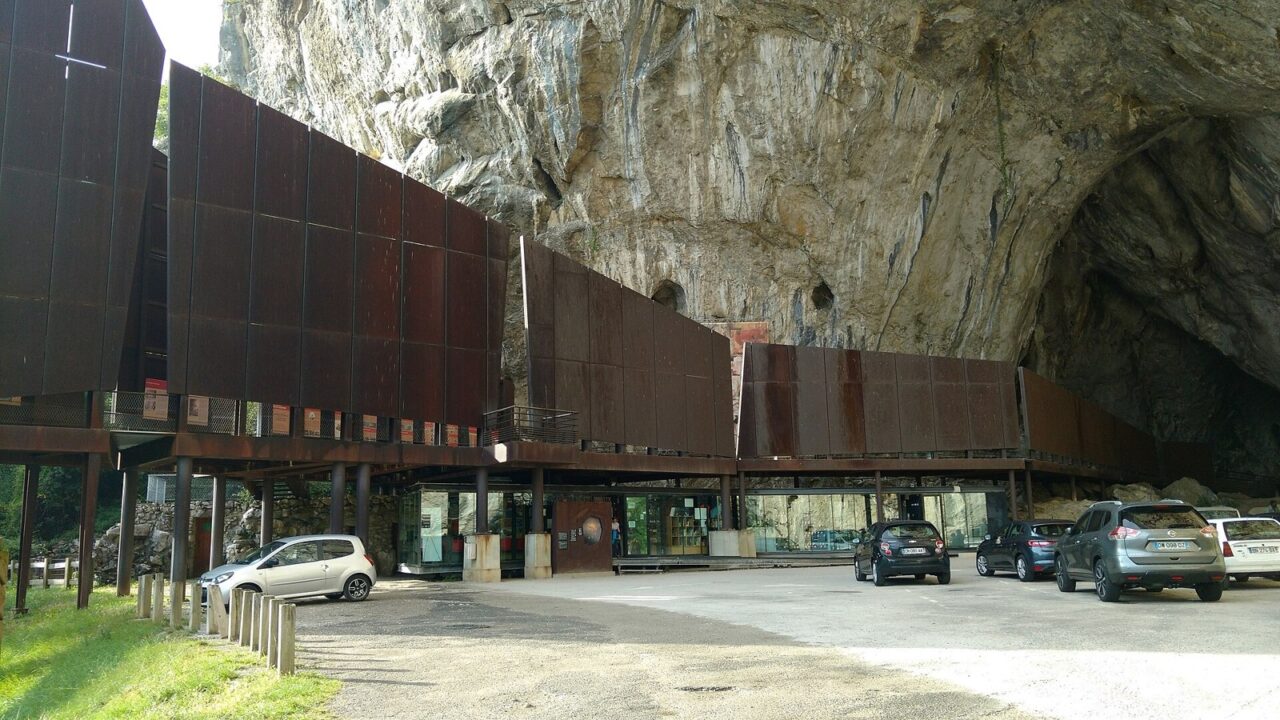
In the heart of the Ariège Pyrenees, in the commune of Niaux near Tarascon-sur-Ariège, the cave of Niaux shelters one of the masterpieces of Magdalenian art, about 15,000 years old. It is vast and deep, and it has a rare quality: it is still open to the public, so you see the paintings exactly where the artists drew them, in the darkness of the mountain.
The Salon Noir
About 800 metres from the entrance opens the Salon Noir, a large rotunda whose walls are covered in animals drawn in black line. Bison, horses, ibex and a stag answer one another in a composition of striking elegance, made with charcoal and manganese oxide. More than 85% of the cave's animal figures are gathered here, over 70 animals on six separate natural panels, with bison dominating.
This remote, hard-to-reach sanctuary was never a place of passage. People came here, probably for ritual purposes, by the light of fat lamps.
An art of line
There are no vivid colours as at Lascaux: the power comes from the line. Contours are laid down with a sure hand, sometimes heightened with shading to suggest volume. All the animals are in profile, with no ground line, as if hanging in the air. The Abbé Breuil wrote that here "nowhere is the line more exact and more sure". Enigmatic signs, red and black dots and sticks, accompany the animals like a graphic language whose meaning still escapes us.
The floor carries art too: Niaux has the largest number of known floor engravings, a rare practice specific to the Pyrenees. They are too fragile to be approached.
How old are the paintings?
Because the lines contain charcoal, they can be dated directly by radiocarbon. In the early 1990s, two tiny samples from a bison in the Salon Noir gave 12,890 ± 160 and 12,440 ± 190 years BP. Careful with units: "BP" means radiocarbon years before 1950. Once calibrated, these correspond to about 14,000 to 16,000 years before today, in the Magdalenian. Pigment analyses also found several different paint "recipes" from one gallery to another, which suggests the cave was decorated in several phases.
Footprints in the Réseau Clastres
The cave network runs for several kilometres. In a distant gallery, the Réseau Clastres, more than 500 human footprints, fixed in sand and clay since prehistory, show that men, women and children really walked here. Discovered in 1970, this gallery of over a kilometre is joined to Niaux only by siphons that can be crossed by diving, so it stayed intact. It also holds five animal figures, including a weasel, the only known one in Palaeolithic cave art. It cannot be visited, but the "dune of footprints" is reproduced as a facsimile at the Parc de la Préhistoire in Tarascon-sur-Ariège.
Centuries of visitors
Niaux was never truly lost. The oldest graffiti date from the early 17th century, and one Ruben de la Vialle left his name near the paintings in 1660. In September 1906 Commandant Molard and his two sons surveyed the Salon Noir paintings and alerted Émile Cartailhac, who authenticated them with the young Abbé Henri Breuil and published them in 1908.
Why the visit is so controlled
After Lascaux closed in 1963, scientists showed that visits to decorated caves had to be limited. At Niaux the underground climate has been monitored since 1972. A visiting protocol was set in the 1980s: no more than 25 people per group, staggered departures, and only the first 800 metres open. According to the operator, no destabilisation of the climate has been observed since. There is no fixed lighting: everyone advances with a portable lamp, like a small team of explorers, in silence and darkness, in front of works drawn some fifteen thousand years ago.
Before you go
- Book online: no ticket without a reservation, and arriving late means losing your place. Arrive 15 minutes before the start.
- Dress for it: walking shoes and a warm layer, as the ground is natural and the cave stays at 12 °C.
- Leave things in the car: bags, sticks and cameras. Photos are forbidden and dogs are not admitted.
- Children: the visit is strongly discouraged for children under 6, and minors must be accompanied. No pushchairs or baby carriers.
Around Niaux
The Parc de la Préhistoire at Tarascon-sur-Ariège shows facsimiles of the Salon Noir and of the closed parts of Niaux, a good complement to see what the visit cannot show. Three other caves in the area can be visited: Bédeilhac, a huge cave where Breuil recognised a Magdalenian painting in 1906; La Vache, at Alliat, a Magdalenian winter dwelling that yielded thousands of objects; and Le Mas-d'Azil, crossed by the Arize river and a road, which gave its name to the Azilian culture. Our two days in the Ariège Pyrenees itinerary ties them together. For other caves, see the guide to painted caves in France, or compare with Lascaux.
Practical information was checked in October 2026: please confirm opening times and book on the official website before your visit.