
In 2026, fifteen original painted caves still welcome the public in France, all checked with their operators. You see walls painted or engraved by Palaeolithic people, on the very spot where they worked. Add two sculpted rock shelters in the Dordogne and three major replicas (Lascaux IV, Chauvet 2 and Cosquer Méditerranée) that reproduce caves closed for ever. The two experiences are very different. Here is how to choose, region by region.
Original or replica: what you will see
An original cave is the wall itself. You enter in a small group, with a guide, in cold and half-light. Places are limited to protect the paintings, booking is almost always compulsory, and the visit often lasts only an hour. No copy gives that silence or that closeness.
A replica (facsimile) is an expert copy, surveyed to the millimetre from the cave. The word "copy" misleads: these recreations show ensembles that nobody will ever see otherwise, with lighting and explanations the original cannot allow. They are more comfortable, often accessible by wheelchair, and open much of the year.
Three great French caves can only be seen through a replica. Lascaux was closed in 1963 after visitors' carbon dioxide and micro-organisms attacked the paintings; Chauvet has never been open since its discovery in 1994; Cosquer opens 37 metres under the sea off Marseille. For these three, the replica is the only way in.
Museums give the keys to what you will see underground. A rule that works: museum first, cave afterwards.
Vézère valley and Dordogne
This is the greatest concentration of open decorated caves in the world. The three sites run by the Centre des monuments nationaux around Les Eyzies are visited only on guided tours, with a time slot booked online, and are closed on Saturdays. Start with the National Museum of Prehistory, above the village.
- Font-de-Gaume, Les Eyzies: one of the last polychrome caves still open. In a narrow corridor, bison painted in red and black 13,000 to 16,000 years ago follow the relief of the wall. Time underground is limited to 30 minutes and the daily quota is small, so book as soon as slots open. Ticket 13 €, free under 18, from age 7.
- Les Combarelles, Les Eyzies: a cave of engravings, several hundred Magdalenian figures along a low gallery. You need a guide to make them appear in raking light. Same conditions as Font-de-Gaume: guided visit of about an hour, online booking compulsory.
- Cap Blanc and the Poisson shelter: at Cap Blanc a frieze of life-size horses was carved in relief in the cliff. It is not a cave, so the visit is short and easy with children. The Poisson shelter keeps a sculpted salmon on a rock ceiling. Both are booked online.
- Rouffignac: the "cave of a hundred mammoths", toured seated in a little electric train for about 1 hour 10, at 13 °C. Open daily from 29 March to 1 November 2026; online sales open about five weeks ahead.
- Lascaux IV (Montignac, replica): the whole cave, including the Hall of the Bulls and the Axial Gallery, painted nearly 21,000 years ago. Timed tickets booked online, 23 € for an adult in 2026.
Gironde and Quercy
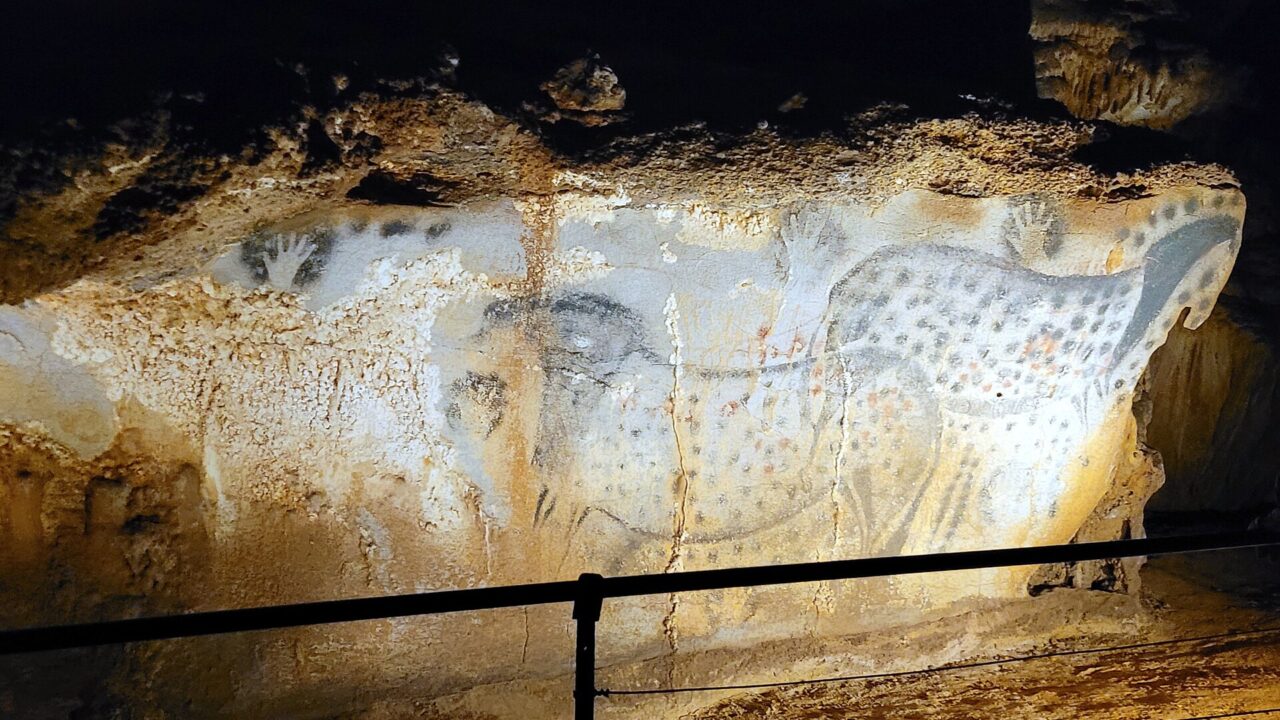
- Pech Merle (Cabrerets, Lot): the most varied ensemble, with spotted horses about 29,000 years old, hand stencils, mammoths and footprints preserved under calcite. One hour in the cave, then the Amédée Lemozi museum, included. Booking compulsory all year, 17 € for an adult; for the same day, you must telephone. 2026 season until 1 November.
Also in the Quercy and beyond: Pair-non-Pair in the Gironde (deep engravings read in raking light), Cougnac at Payrignac (ibex, mammoths and human figures) and the small Grotte des Merveilles at Rocamadour (telephone booking only).
Pyrenees
- Niaux (Ariège): you earn it. You walk about 800 metres in the dark, lamp in hand, to the Salon Noir, where bison, horses and ibex were drawn in charcoal about 15,000 years ago. No fixed lighting, groups of 25 at most, about 1 h 45, 12 °C all year. Online booking compulsory, 17 € for an adult. Strongly discouraged before age 6, impossible by wheelchair.
- Parc de la Préhistoire (Tarascon-sur-Ariège, replica): a reproduction of Niaux's Salon Noir, a good complement with children too young to walk underground.
- Gargas (Hautes-Pyrénées): the largest group of prehistoric hands in Europe, often with incomplete fingers, made in the Gravettian, over 25,000 years ago. Guided 50-minute visit; booking compulsory.
Also in the Pyrenees: Bédeilhac, with clay modelling about 16,000 years old, and Isturitz and Oxocelhaya in the Basque Country.
Burgundy and Mayenne
Arcy-sur-Cure (Yonne) has paintings over 28,000 years old, visited on guided tours from April to November.
- Grotte Margot (Saulges, Mayenne): the only decorated cave open in western France, with engravings about 25,000 years old, recognised only in 2003. A 40-minute visit, 15 people at most, from age 3. Open until 14 November 2026.
Replicas in the Ardèche and Provence
- Chauvet 2 (Vallon-Pont-d'Arc): lions, rhinoceroses, horses and mammoths drawn 36,000 years ago. A guided hour in the replica, then a gallery and exhibition: allow half a day. The whole site is wheelchair accessible.
- Cosquer Méditerranée (Marseille): the drowned cave, seen seated in an exploration module for 35 minutes. Timed tickets, 19 € for an adult. Not for under-3s.
Which one should you choose?
- First visit: one replica and one original, in that order if possible. Lascaux IV then Font-de-Gaume, or Chauvet 2 then a cave in the Lot.
- Children under 7: Rouffignac by train, Cap Blanc, Grotte Margot (from age 3) or the replicas. Avoid Niaux and narrow, long caves.
- In winter: Font-de-Gaume, Les Combarelles, Cap Blanc, Pair-non-Pair, Gargas and the three replicas stay open. Niaux moves to weekends from November. Most others close in early November.
- One day in the Dordogne: the museum in the morning, Font-de-Gaume or Les Combarelles in the afternoon, Cap Blanc at the end of the day, Lascaux IV the next day. Our Vézère valley weekend lays it out.
- If you cannot walk far: Rouffignac, Chauvet 2 and Lascaux IV.
Booking and preparing your visit
- Book the cave first and organise the rest around it. For the most sought-after originals, allow several weeks in summer; Rouffignac opens sales about five weeks ahead. For the replicas, the day before is often enough outside the holidays.
- Arrive early: 15 to 30 minutes ahead; being late often means losing your place.
- Bring a jacket, even in August: the caves stay between 12 and 14 °C.
- No photos in decorated caves, even without flash, and often no bags.
Practical information was checked in October 2026: please confirm opening times and book on the official website before your visit.